Charlotte Mason Picture Study: A Simple Guide for Your Homeschool
This post shares a simple guide to getting started with Charlotte Mason picture study, reasons why picture study is important, and recommendations for where to find art prints and resources.
When I first heard about Charlotte Mason’s idea of picture study, I was afraid it would require lots of art knowledge (which I don’t have), expensive prints (which I don’t have), and a lot of prep time (which I don’t have).
In reality, it has turned out to be one of the simplest and easiest parts of our homeschool day.
Picture study is a not just a core part of a Charlotte Mason education, but it is also simple way to add art appreciation into your homeschool. Thankfully, the tools it requires are minimal and inexpensive!
We’ve done quite a bit of this picture study during our almost-eight years of homeschooling (with anywhere from 2-5 kids, depending on the year and how old everyone was), and I have even done it in a slightly larger group setting (8-9 kids) during our Classical Conversations class. It’s worked perfectly in each of these different situations.
Keep reading, and I’ll show you exactly how picture study works and how you can easily add it to your own homeschool!
What Is Charlotte Mason Picture Study?
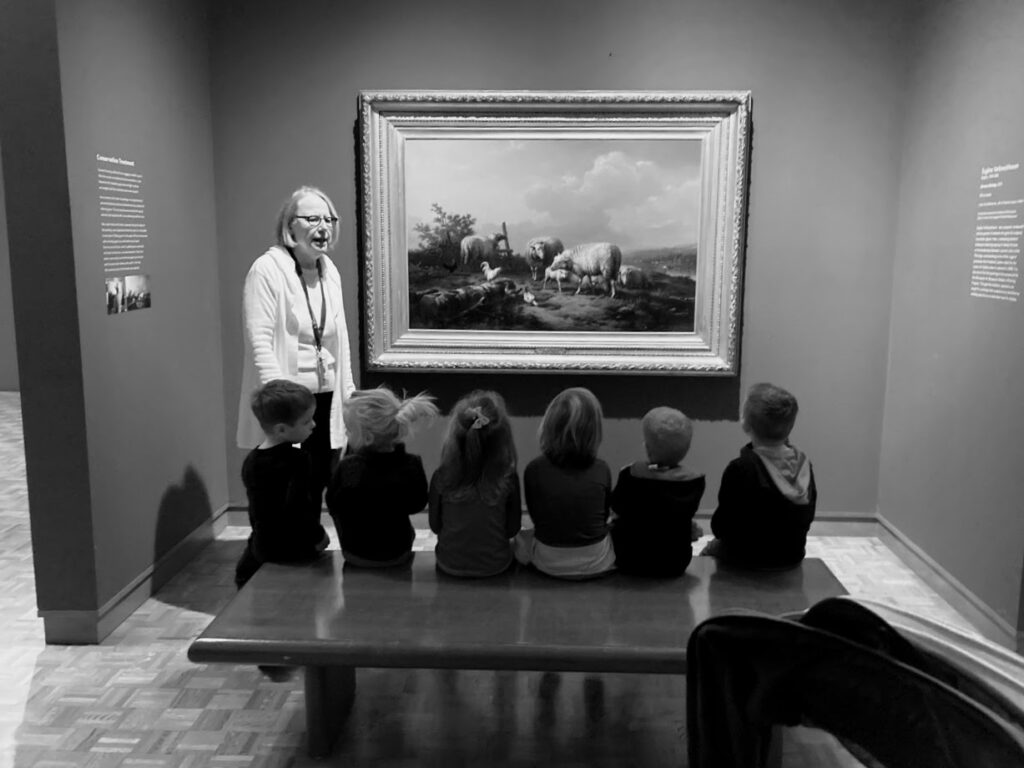
Picture study is simply Charlotte Mason’s approach to art appreciation. The basic idea is that children will carefully observe a work of art and then tell what they saw. Please note that this does NOT involve analysis of the art: that may come later, but when children are in elementary or middle school, it is far more important that they learn to enjoy and appreciate the art, rather than analyze it.
In general, children need a synthetic approach to education, rather than an analytical one – and picture study fits perfectly with this approach.
I like to think of it as “making friends” with the artist. We want to find things we like about the art, take pleasure in seeing it, and perhaps even be able to recognize the artist’s style the next time we see it in a book or in a giant framed print inside Hobby Lobby.
Why Should We Do Picture Study in Our Homeschools?
The more that I read Charlotte Mason’s writings and try out the things she recommended, the more I realized that everything she suggested was for a reason. Picture study has been such a lovely addition to our homeschool morning, and one of the best reasons we keep doing it is simply because everyone likes it! Beyond this, however, here are a few more reasons why picture study is valuable and worth your time:
1) It encourages careful observation.
I am continually amazed, every single time we do this, at how – no matter how carefully I look at the picture – the children will see things that I never even noticed. It is amazing! And in a world with constantly flickering screens that fragment and destroy our powers of attention, the more we can do to our encourage our children to slow down and pay attention, the better.
2) It builds familiarity with great artists.
If you continue with picture study consistently, over time your children will become familiar with famous painters and styles. What’s more, you will become familiar with great artists and their styles! It really doesn’t matter if your child can name the art period, techniques, or any facts about the artist (though you can add these in IF your child is interested); what matters is that they learn to notice, enjoy, and appreciate the art that they see.
You can memorize art history periods and artist facts all day long, but it is only repeated and careful observation of their actual art that will allow you to someday enter a museum, see a painting you’ve never seen before, and say. “Wow, that looks like a Van Gogh!”
3) It develops narration skills and memory.
Picture study is another form of narration. Children are taking in some information (in this case, through their eyes rather than their ears), processing it, remembering what they saw, organizing their thoughts, and expressing it in their own words.
This requires a LOT of thinking, and the more practice in narration we can give to our children, the better speakers (and eventually, writers) they will become.
4) It cultivates a love for beauty.
This fits perfectly with Charlotte Mason’s idea of spreading a “feast of ideas” before children. Charlotte was convinced that children do not require simplistic, cartoon-ish “children’s” art – instead, they are fully capable of understanding and appreciating the greatest art the world has to offer!
However, just because children can learn to appreciate this sort of art (or music) doesn’t mean that it comes naturally for every child, or that they will forge an instant connection with the art.
A love for and understanding of great art and music needs to be cultivated, and picture study is one way to do so.
5) Everyone can do it!
This is a huge perk for anyone with more than two children. The more subjects that you can do as a whole family, the smoother and more efficient your homeschool day will become. I love that absolutely anyone – from the two year old toddler up to grandma and grandpa – can look at a piece of great art and share what they notice!
“But there must be knowledge and, in the first place, not the technical knowledge of how to produce, but some reverent knowledge of what has been produced; that is, children should learn pictures, line by line, group by group, by reading, not books, but pictures themselves.
The little pictures are studied one at a time; that is, children learn, not merely to see a picture but to look at it, taking in every detail. Then the picture is turned over and the children tell what they have seen… there is enough for half an hour’s talk and memory in this little reproduction of a great picture and the children will know it wherever they see it.“ ~ Charlotte Mason
How Picture Study Works
Don’t be intimidated. This is one of the actual simplest things we do in our homeschool! It takes a tiny bit of prep upfront at the beginning of the year, but during the school year there is NOTHING else that I have to prep or get ready.
Step 1 (before the school year begins): Choose an Artist… Or Three
Charlotte recommended choosing one artist per term, but – as with everything else in homeschooling – this is really up to you. For us this year, we didn’t do any picture study during the fall, but then this winter/spring semester I chose several artists that matched up with our Classical Conversations artist cycle.
If you’re looking for ideas of artists to study, Ambleside Online has fantastic lists both of artists and which pieces of their artwork are suitable for children!
Step 2 (before the school year begins): Choose Several Paintings or Pieces of Art
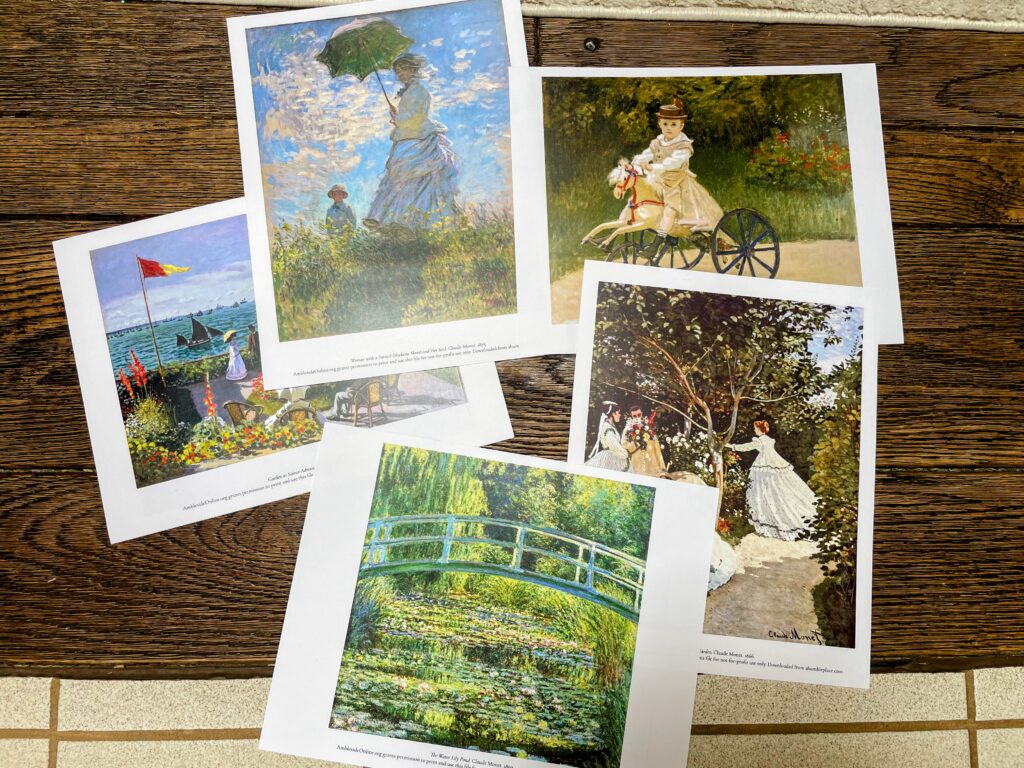
I do not have a lot of experience in art history myself, so I tend to let other people choose these for me. That is, I will buy a pre-selected set of art prints but I do not choose the individual pieces myself (I will share links to the places I get them at the bottom of this post!). It’s really up to you how many pieces you choose for each artist, but you probably need at least 6-8 to really get a good sense of the artist’s style.
It’s ideal if you can get these art prints before your school year begins, but it’s honestly not the end of the world if you forget to order them until the week before you start that artist. I have done both.
Step 3 (once you’re ready to begin): Choose One Picture and Look at the Painting Carefully
This is the fun part! Once you have your artist chosen and your art prints ordered or printed, then on the day when you are ready to begin, all you have to do is pull out one picture and look at it. I usually remind the kids of the rules: “We are going to look at this together QUIETLY for two minutes. That means NO TALKING ABOUT IT yet. That means your mouth is CLOSED and your eyes are OPEN.”
Sometimes I’ll suggest things to look for – “See how many different colors you can spot!” – and other days I won’t. Up to you.
Step 4: Hide the Picture
Putting away the picture at the end of the 2-ish minutes forces the children to pay attention during the “looking time,” because they will not get another chance! It also encourages them to think and remember what it was they actually saw without relying on another peek at the picture.
At this point I will ask, “What did you see?” and let them take turns telling me. Usually all of them are very eager to do so! They take great pride in noticing some detail or color that no one else noticed, and it’s great fun to see how different everyone’s observations are.
Step 5: Look Again
Sometimes I will pull the painting out again in order to confirm some detail (“Did you really see a dog there? I thought it was a stump!”), or to point out something that the children didn’t notice.
However, I do my best to avoid lecturing and to keep the whole experience brief. This ensures that we all enjoy it and are eager to do it again the next time!
How Often Should You Do Picture Study?
Again, it’s up to you and there are many good options. Charlotte Mason recommended once a week, but as I mentioned before, we’ve had semesters where we didn’t do it at all, and then other semesters where we did it 2-3 times a week.
Either way, consistency is important. I would not recommend doing picture study 5 times in one week and then not again for the next three weeks! At least a month or two of consistency really helps your kids to understand the process, start to learn how to pay attention, and get better at telling back what they saw.
More Tips for Picture Study in a Busy Homeschool
I hope you are now convinced that picture study is both EASY and WORTHWHILE! Here are just a few more tips based on our experience with it:
- The simplest way for us to fit this in is to add it to our homeschool morning time. Another easy option could be to look at the picture at the table during breakfast or lunch time!
- It’s ideal if you can have art prints printed off on thick, sturdy paper (more durable for little fingers); however, in a pinch you could just grab some large art books from the library and show a picture from those books each day.
- Go big or go home! The bigger the print, the better. No one likes to squint and guess about what all those little details are.
- If you have a large family, you might want to print multiple copies of each paintings (I printed three of each this year). This way two kids can share one print to look at, rather than all six of us huddled over one little print.
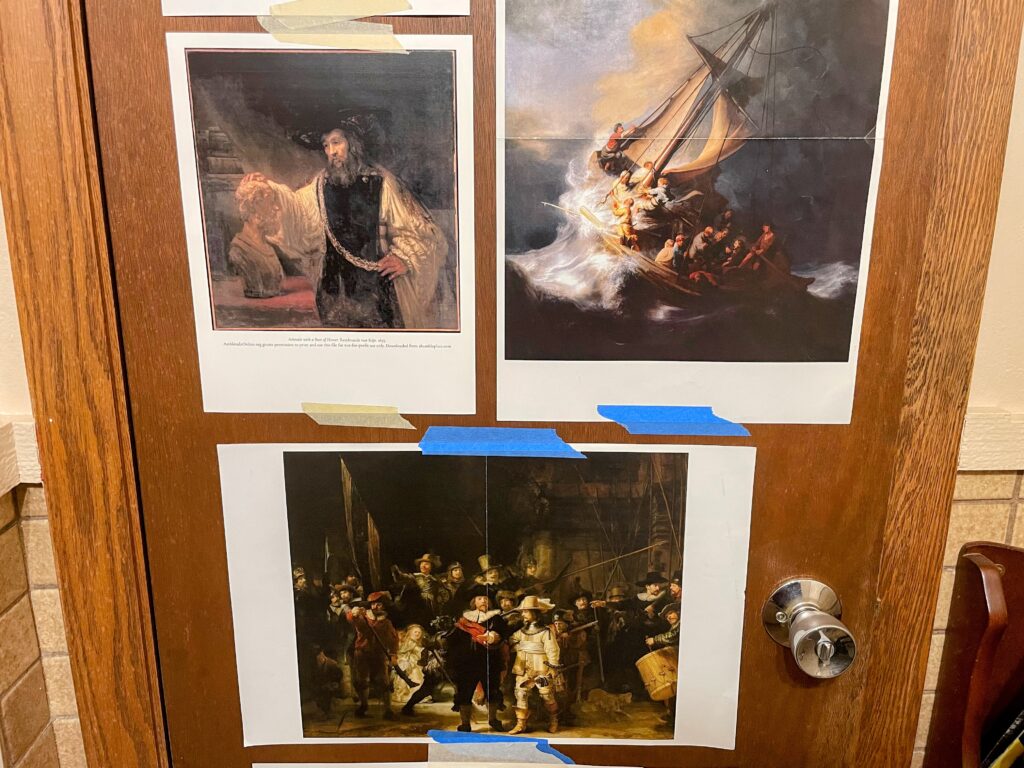
- After we’ve looked at our picture for the day (or week), I like to tape it up in our bathroom! That way we get to keep enjoying it even longer – and what better place to “sit and stare” than the bathroom? You could also try displaying it in your school area or on your fridge.
Picture Study Questions You Can Ask
Charlotte Mason suggested very few questions – rather than telling our children what to see, our goal is to help them express what was meaningful to them – but sometimes a few simple prompts can help get them thinking.
If your children need some guidance or encouragement to tell what they saw, consider asking:
- What was interesting about this picture?
- What colors stood out to you?
- What do you think is happening in this scene?
- Is there anything that was confusing?
- Does this remind you of any other paintings/artwork you’ve seen?
Picture Study Resources
Again, you do not need many supplies! I have bought my art prints from two different sources:
- Memoria Press art prints (I like the bigger 11×17 size – it’s easier to see details in the art)
- Most of the artists listed on Ambleside Online also have an option to download a set of their art prints for free – then you can either print them at home, or pay to have them printed at FedEx or Office Max (I did this, and it was well worth it for a higher quality color and paper)
As I mentioned before, you can usually find many large anthologies of artwork at your library and those can be a good option as well. Biographies of the artists are optional, but could be fun to set out on your coffee table and see if any kids take an interest!
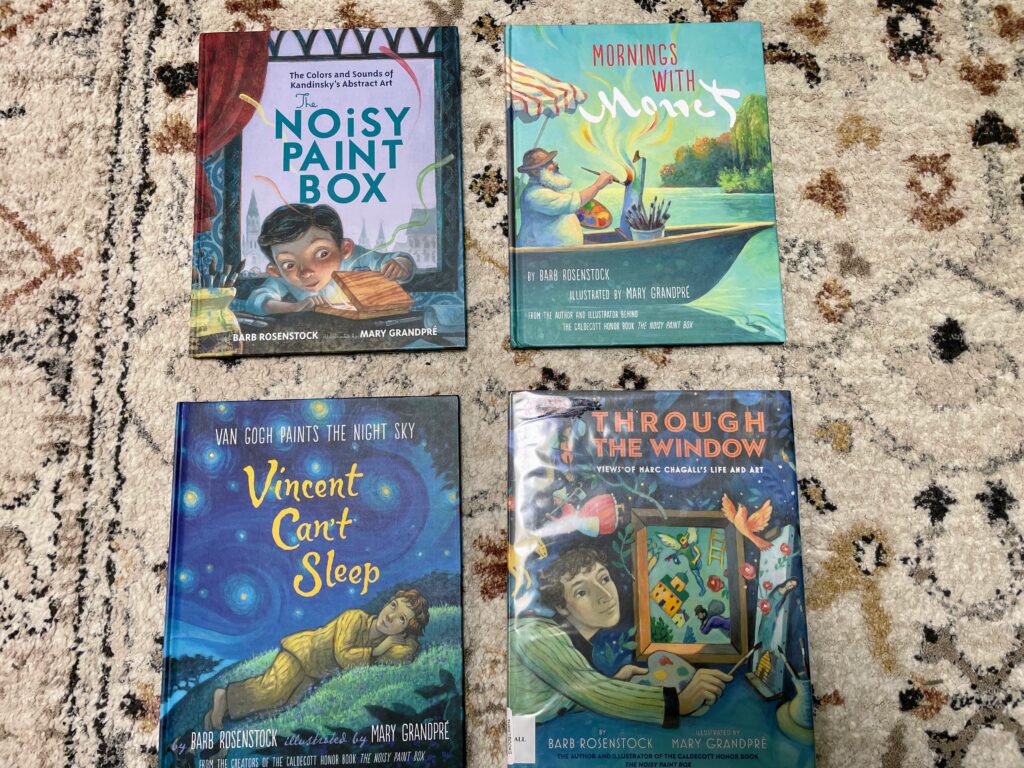
Some of our favorites are these picture books by Barb Rosenstock:
Conclusion
Listen, I’m not one to tell you to add more to your homeschool day unless it is truly worth your time. Picture study falls into this category because the life-long benefits far outweigh the minimal time and effort required!
And again, if it ever starts to feel difficult or time-consuming or like it has drifted into the “kids squirm uncomfortably while mom lectures” territory (yes, I find myself there on occasion too) – then perhaps it’s time to either take a break or cut back. Review the steps above, ask yourself if you’re adding in too much fluff, and pare it back to just the basics!
A few weeks ago our four year old was about to go potty and my husband noticed that – rather than leaving the door wide open as usual, so that he can yell for help when needed – the little guy was carefully closing it all the way. When asked why he was doing that, he yelled happily, “Because I want to look at THE PRETTY PICTURES!”
Great art has the ability to touch us all, whether it’s in a library book or on the back of the bathroom door; whether we are four years old or forty years old.
Give it a chance, and see what happens.
“Every child should leave school with at least a couple of hundred pictures by great masters hanging permanently in the halls of his imagination . . . At any rate he should go forth well furnished because imagination has the property of magical expansion: the more it holds, the more it will hold.“ ~ Charlotte Mason