How to Homeschool a First Grader: 4 Simple Tips
This post shares our Charlotte Mason style approach to homeschooling first grade, 4 important things to focus on during first grade, as well as encouragement that first graders don’t need long hours of school each day! We’ll also touch on what to do if your first grader resists school.
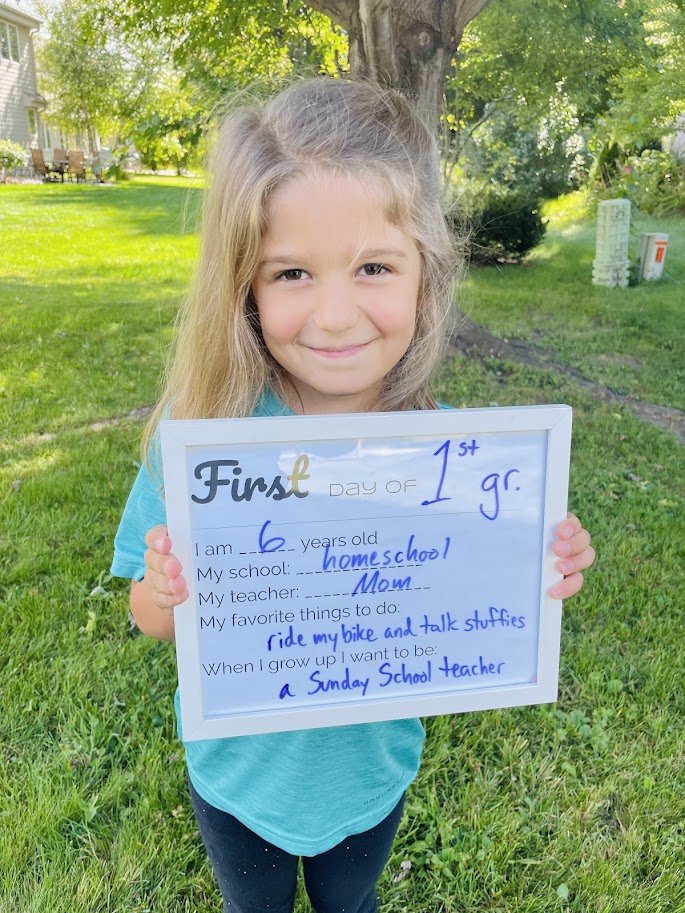
As I type this, in the spring of 2026, Little Sister is finishing up her first grade year. She is now the fourth child we have homeschooled through first grade, which is mind-blowing! These years are cruising by faster than those crazy Chicago drivers down south of us.
So, what has changed since we homeschooled our first first grader, six years ago? What have we learned in the process of teaching four (very different) children?
The biggest change is that we have simplified and pared down to the essentials. The reasons for this have been partly practical (our current first grader has three older brothers who also need my attention!) and partly philosophical (as I’ve become more convinced of the importance of imaginative play and outdoor time).
If your first grader is your only child you are homeschooling, you will likely have the time and brain space to do more than what I have listed below. If this is the case, and you and your child both want to do something more, go for it!
However, I would like to encourage all homeschooling parents that you do not need to do more than this for first grade.
A simple, short homeschool day is all that your first grader needs – and if they spend most of the rest of their time in imaginative, creative play, outside when possible, with a loving family around them… well, that’s a pretty fantastic atmosphere for any 6 year old to thrive in.
Important Reminder #1
Listen up, friends. I know that 6 years old sometimes feels like such a BIG KID – especially if this is your first. However…
First Graders Do Not Need Hours of Bookwork, nor Do They Need to Sit in a Desk All Morning.
These are still little kids, and they still have a very high need for play as well as an entirely normal dislike of sitting still for long periods of time. If your first grader still struggles to read fluently, doesn’t want to spend an hour doing worksheets, and keeps rolling around the floor while you’re reading aloud…. this is 100% normal.
Some of my first graders were reading well and some weren’t.
Some loved worksheets and some didn’t.
Some liked to sit quietly during read alouds and some were literally climbing the walls.
There is a wide range of normal here, with boys often tending towards the more active side of the spectrum. Don’t be too quick to imitate the public school model of education and make your first grader do hours of worksheets and busywork! This approach does far more harm than good.
Reminder #2: What We Did in Kindergarten
I wrote a post about homeschooling kindergarten a little over a year ago, and shared the four things we focus on during a kindergarten year. If you’d like the Cliff notes version, here they are: we teach our kindergarteners… 1) that reading is great fun; 2) that childhood is for play; 3) that counting is useful and 4) that character matters.
Read the post I linked if you’d like more details about what that looks like practically in your home!
While I am very much against the idea of pushing little kids into academics too hard and too early, it is still true that first graders are a little older, a little more mature than kindergarteners, and can probably do a little bit more.
Which then begs the question – what should we do with them? How can we honor their growing brains and bodies without overwhelming them with tasks that first graders were never meant to be attempting?
I would humbly suggest that, just like in kindergarten, we focus on four main areas for homeschooling first grade.

Four Things to Teach When Homeschooling First Grade
#1: That Reading is Great Fun
“But wait!” you say. “Isn’t this the same thing you said for kindergarten??”
Yes, it is, but I would argue that it should be one of our main focuses for the entire elementary school years. Why? Because being able to read well and easily is the foundation for all education in the upper years, and the best way to prepare your children to be strong readers is to show them, over and over and over again, that reading is great fun.
How do we do this practically?
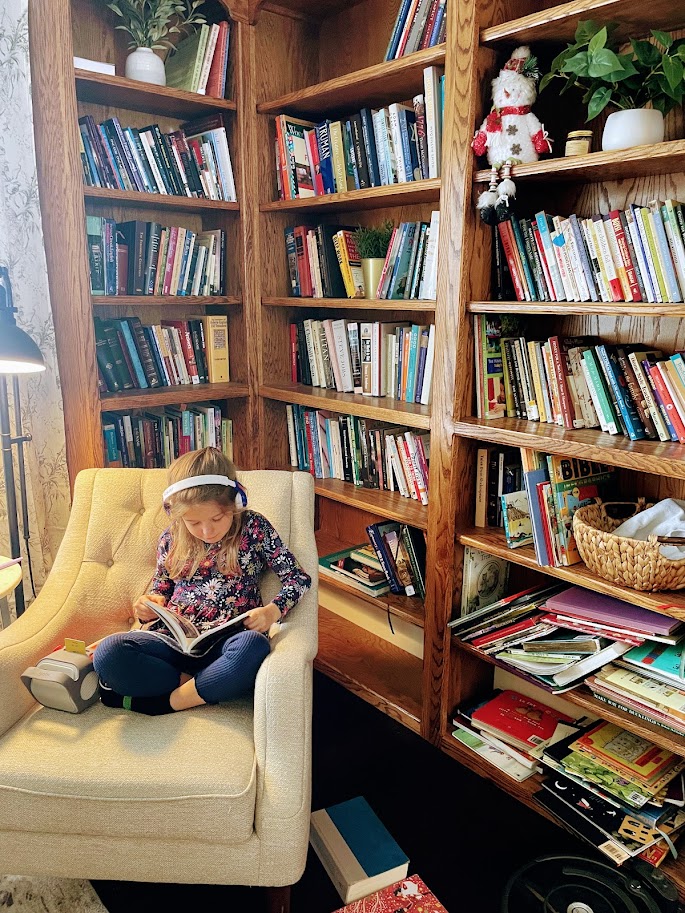
- By reading aloud, every day. Show your child that books are wonderful, that stories are magical, and that reading is one of the best parts of the day!
- By reading your own books, and letting them see you do it. Reading is not just something for school-age children who are forced into it – in our family, we are all life-long readers, and Mom and Dad read because they want to.
- By making the effort to find good books that you AND your child enjoy. If you need help with this, check out the post I wrote on living books and how to find them.
- By continuing on with (or starting) a phonics program. Maybe reading has already clicked for your child – or maybe it hasn’t yet. All of my children had a “lightbulb moment” day (or week), where everything seemed to click and they suddenly got the hang of sounding out words – and this happened at a different age for every child. Be patient, and keep on with short but consistent phonics lessons this year.
#2: That Math is Interesting and Useful
Again, this is very similar to the kindergarten year. If you didn’t use a math curriculum last year, that’s just fine! This year might be a good time to begin. If you did use a math curriculum last year, think about how it went, and whether you want to continue with it or choose a different one.
There are many fantastic math books (we’ve used The Good and The Beautiful for the last several years, but others are good too), but no matter what you choose, I would encourage you to again keep the lessons short and remember that curriculum is always your tool, not your master.
So how do we practically show that math is interesting and useful?
- By pointing out when we use math in everyday life. This could be while cooking or baking, while at the grocery store, or while deciding which sale is the better deal.
- By keeping math lessons short. One thing I’ve been surprised by this year is how repetitive our first grader’s math curriculum is. It feels like we keep doing the same things over and over again all year, just in different formats! However, this is encouraging to me because it tells me that first graders don’t have to learn tons of new things. All we are doing is practicing basic concepts and making sure they’re understood – and generally, this practice is most effective when we don’t push our little kids too far past their natural attention span.
- By leaning into your child’s natural learning style. Some kids LOVE worksheets – if so, use some! Others need to hold something in their hands, and learn best with alllllll the manipulatives. One of my kids needs me to read every single instruction to him so that he can hear it and process it that way. Experiment with these (and more) to see what works best for your child.
- By playing lots of games. Board games and card games are FANTASTIC ways to either introduce or practice math concepts (here are a few of our favorite family board games)! You should absolutely count any game-playing time as part of your math for the day, and perhaps every once in a while you can gently point out the sort of math they are using. “Look at what a good counter you are now! It would be pretty hard to move your piece the right number of spaces if you didn’t know how to do that!”
#3: That They Are an Important Member of The Family
By first grade, most children are quite capable and eager to participate in family life – probably more so than we realize! The more we can draw them in and let them be a part of what’s going on around the house, the more they will gain confidence and the security that comes from knowing, “I belong here. This is my family, and I am an important part of it. They need me and I need them.”
Giving our children this stability is a large part of their education.
How do we do this practically?
- By assigning (and teaching) age-appropriate chores. You can find plenty of chore lists online for every age imaginable, and I don’t need to add another one here. But I will encourage you that the time you spend teaching, reminding, and checking in on the chores is well worth it! Yes, it’s a lot of time and effort in the young years – but I can promise that you will reap dividends in the near future, and you will never regret it.
- By inviting them to help you. Whether you are cooking dinner, rearranging the bookshelves, painting a bedroom, or changing a tire on the van – ask your child if they want to help! There is likely a small job they can do for you to truly help; and if not, even letting them stand near you and explaining what’s going on can help them to feel like they are part of the project. Again, this might mean your project takes longer – but it’s an invaluable learning experience for your child.
- By creating and maintaining boundaries for them. Hopefully this is merely a continuation of what began in the toddler years, but all children need to know that they are not in charge and that someone else is. This is actually very reassuring for children; as much as they may claim otherwise, they do not want to be in charge of the family! Maintaining boundaries (“This is not allowed in our family”) and giving consistent consequences for crossing those boundaries gives a child a deep sense of security and confidence.
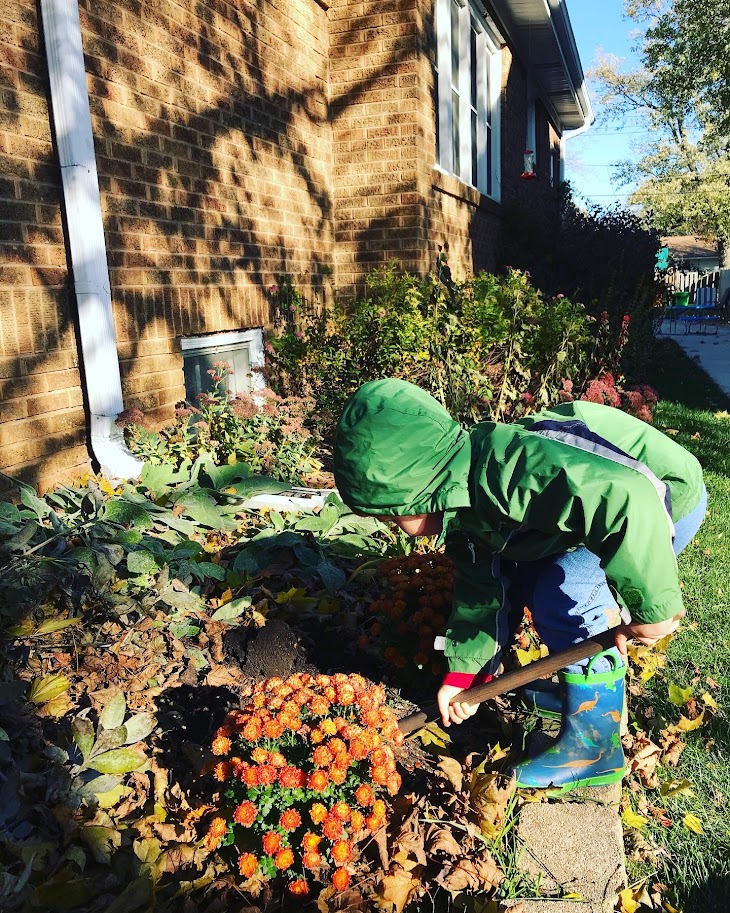
#4: That Nature is Worth Exploring
Some children take to the outdoors naturally, and never want to come in – others would much rather spend the whole day indoors on the couch with a book. We have some of both in our family! However, even the bookworms need to learn the joy of exploring nature, and the younger we can begin, the better.
The earlier we start good habits in our children, the easier it is to do it, and getting outside is no exception. When we begin the habit of getting outside (nearly) every day – perhaps even shooting for 1000 hours outside! – we are giving our children a huge gift that will serve their physical, mental, and emotional health throughout their entire life.
How do we do this practically?
- By going out with them. Truth be told, there are many many times when I just need ALL THE CHILDREN OUTSIDE RIGHT NOW so I can have a moment of quiet to calm my brain. However, I need to make sure that there are also plenty of times when I am out with them. Hypocrisy never serves us well, and outside time is just as good for me as it is for them.
- By exploring new locations beyond our backyard. This does NOT have to be fancy, exotic, OR expensive. This could be as simple as a new playground, or a walk through a part of the nearby woods that you haven’t explored yet! New locations introduce a tiny bit of adventure into our ordinary days, and when we do it with our children, it helps to bring more connection and joy into our relationship. Plus there is often the delight of spotting a new bird, insect, or tree that you’ve never seen before!
- By slowing down and paying attention. This is our whole approach to homeschool nature study! When we get out in nature with our children, get off our phones, and start paying attention to the beauty around us – this is where the magic happens. You’ll be amazed at what you’ll notice.
Bonus: What if My Child Resists School?
In our experience, 5-7 year olds are still very much in the “childhood wonder” and “excited about everything” stage – and it’s so delightful! They generally want to know things, are thrilled to discover new parts of the world around them, and want to be a part of all the real life happening at home.
If this is not the case for you, I’d suggest three things to consider:
- Perhaps you’re spending too much time on school. For our first graders, we generally spend no more than 30 minutes (combined) on their phonics and math work. There might be another half hour of me reading aloud to them at some point during the day – and that’s it! One hour of official school time per day. And yes, THIS IS ENOUGH. We have done this for all four first graders now, and all four children are currently reading at or above their grade levels as well as progressing so quickly in their math. Too much more than this, and you risk burning out your child – causing them to think that school is too hard or that they aren’t “good at school.” And what a tragedy that would be.
- Perhaps you need to re-establish boundaries and consequences. If you’re only trying to do half an hour or less and it’s still a struggle, especially if you see your child fighting you in other areas of life too, it could be a case where they have never learned the habit of listening well and respecting what you say – so why should they start now? And before you start huffing and puffing, please know that I am saying this with so much compassion because it has happened to me, too. Sometimes our homeschool doesn’t work because our parenting hasn’t worked! Consider honestly whether you need to be more consistent in enforcing routines of helpfulness, respect, and obedience. Some time spent working on these (outside of school time!) will lead to a more peaceful homeschool, and a happier child too.
- Perhaps your child has some learning difficulties or differences. If you’re only doing a short bit of school, and your child is generally in the habit of listening and respecting outside of school (no child is perfect, but we’re looking at patterns here), maybe there is something going on that is making the school work extra difficult for him. Could they have some dyslexia going on, or vision problems, or perhaps be on the autism spectrum? Are they getting enough sleep? Consider if there could be some physical, mental, or emotional issue that is preventing them from enjoying and succeeding in their school work, and talk to your pediatrician if you think that might be the case.
Conclusion
I love first grade! In our experience, kids are generally past most of the turbulent toddler emotions, but still so eager and excited about life… it’s a wonderful spot.
I hope that these suggestions have given you encouragement that homeschooling first grade can be simple, joyful, and still provide the soil your child needs in which to grow and flourish.
Ultimately, you know your child best. If you feel they need a bit more than this – go for it! If you are convinced they need a bit less than this – go for it! Pray for wisdom and then trust your God-given instincts.
You are your child’s best teacher, and home is the perfect place to learn.
“Our children need our time, not our intelligence. They bloom with love, not perfect language skills. They need mercy, not intellectual mastery. And they will learn – indeed, truly learn – when they are given time to explore ideas without constant fact-checking and examination.” ~ The Call of the Wild and Free by Ainsley Arment