25 Beautiful Picture Books About Music for Children
This post shares our favorite picture books for homeschool music, including books about the orchestra, books about specific composers and performers, and books about classical music in general! We’re also talking about 3 ways to use picture books of any variety in your homeschool.
Picture books are one of our favorite ways to learn, for all ages – not just preschoolers! Honestly, I enjoy these picture books just as much as my children do, if not more.
If you’re curious about adding more classical music education to your homeschool but not sure where to begin, let me humbly suggest that picture books are the PERFECT starting point.
Why? Because they are beautiful, engaging, and easy to read!
No need to plan a detailed curriculum plan. No need to spend big bucks on a fancy unit study. All you need is a library card and the ability to read to your children!
Whether you are a homeschooling mom looking for the best picture books about music to add to your homeschool routine, or simply a parent with children interested in music, these are our top favorite picture books about musicians, orchestras, classical composers, and so much more.
You Don’t Have To Be a Musician
Classical music can feel very intimidating. If you’ve never had much experience with it, it can feel strange, confusing and even… boring!
However, let me assure you that a) you don’t have to understand it before you can share it with your children and b) like great works of literature, classical music rewards the effort you give. The more you understand of it, the more you will appreciate it and even come to love it. Classical music simply has a depth and complexity to it that most (not all) pop songs cannot compete with!
You do not have to be a musician.
You do not have to have experience with classical music or any prior knowledge about composers.
You do not even need A CURRICULUM!
As with most homeschooling subjects, all you need is a little bit of curiosity, willingness to learn, and some great books to help you out.
How to Use These Picture Books About Music
There are many effective ways (and very few wrong ways) to use these books. Here are three tools that you can try at home when presenting picture books – on any topic! – as well as one way of using picture books that I would strongly encourage you to AVOID.
Tool #1: Strewing
One effective tool that homeschoolers love is STREWING. This simply means that you lay out books (or craft supplies, or interesting pictures, or…) somewhere where the children will notice them and then DO NOTHING except observe what happens. You do not mention the books, you do not draw your child’s attention to them, you do not ask if they want to read them with you – you simply wait.
Why it works: When our children discover these books (or pictures or supplies or whatever) ON THEIR OWN, they are much more likely to take ownership of it. Children love independence AND they love making discoveries, so strewing – which combines both of these loves – is often incredibly effective. Plus, after they’ve “discovered” these interesting books, they get to show you, or maybe even tell you something you didn’t know – and what an delightful role reversal that is.
Important Note: sometimes it works (my children will find the books and immediately start reading); other times it doesn’t work (the books are completely ignored by everyone). Don’t be discouraged if no one seems to notice your strewing efforts! The whole point here is that your child has a choice (to interact with them or not), and the existence of a choice means that sometimes they will choose not to do so.
If I’ve given strewing a chance for a few days and no one seems interested, then I might move on to…
Tool #2: Read Them Aloud
If your children are young and already used to reading picture books with you, this is a simple and natural next step. Gather them on the couch, grab a beautiful book, and start reading! If no one likes the book, return it to the library and don’t read it again.
But if everyone is quiet, absorbed in the pictures, and asking you to read it again as soon as you finish the last page – then you know you’ve found a winner.
Important Note: if your kids are getting older, and snuggling up on the couch with a picture book starts to feel a little odd (or it’s just harder to find time for it!), here are two things to try. 1) Start reading it out loud to “just” your youngest child at a time when the older children are nearby. Whenever I do this, without fail, the older ones wander over and inevitably start listening too. There’s something about a good story that draws everyone in! 2) Read it aloud during lunch or breakfast. This is a good option when the older kids’ days are getting more full with school work and you can’t seem to find time to sit and read through stacks of picture books anymore.
If the picture book is more along the lines of a reference book or simply has too many pages & facts to be read in one sitting, then I might…
Tool #3: Pick & Choose Sections
Listen. There’s no rule that says YOU MUST READ EVERY WORD OF EVERY BOOK THAT ENTERS YOUR HOUSE. Truly!
Some of these books lend themselves more to being used as reference books, and we might just read a page at a time, here and there. Maybe you listened to Beethoven’s 5th Symphony in your co-op, and so you look up the page about the Romantic time period. Maybe you flip through a book about instruments and ask your kids which one looks like fun to play. Maybe you heard Copland’s Appalachian Spring and loved it, so you look up other pieces he composed. Maybe you find a page about the trombone, because your husband’s brother’s wife’s aunt plays one, and you read about what it’s like.
All of these are great ways to dip your toe into the pool of classical music without drowning in facts and terms you don’t understand.
Just DON’T Do This…
The biggest thing I would be careful about when bringing picture books into your home is simply this: DO NOT treat them like a school assignment. Picture books are for delight and joy, and the most effective way to kill this delight is to quiz your child about what they read, or ask them “comprehension questions” afterwards, or to drill them on the facts they heard.
Sure, there are MANY conversations that naturally occur after we read picture books.
Sure, you can casually ask them what they liked about the book, or what they thought was interesting (this is narration, after all).
Sure, you can absolutely count this as part of your school day!
But there is a huge mindset difference between a mother who is simply enjoying a beautiful book along with her child (and will gladly discuss questions that come up, if the child wants to) and a mother who is subconsciously anxious that her child will not learn from this book unless she does something to force it.
A Difficult Truth for Devoted Mothers to Acknowledge: good books do not need your commentary or explanation. They are whole and complete on their own, without your interference. Trying to force-feed more knowledge into your child will not increase their comprehension and will actually backfire, because it makes the whole reading experience so much less enjoyable.
All right, let’s dive into the books!
As always, please know that I link to these books on Amazon simply because it is easy, but I highly encourage you to get them from your library if you can, and also to support your local independent bookstores!
Picture Books About the Orchestra
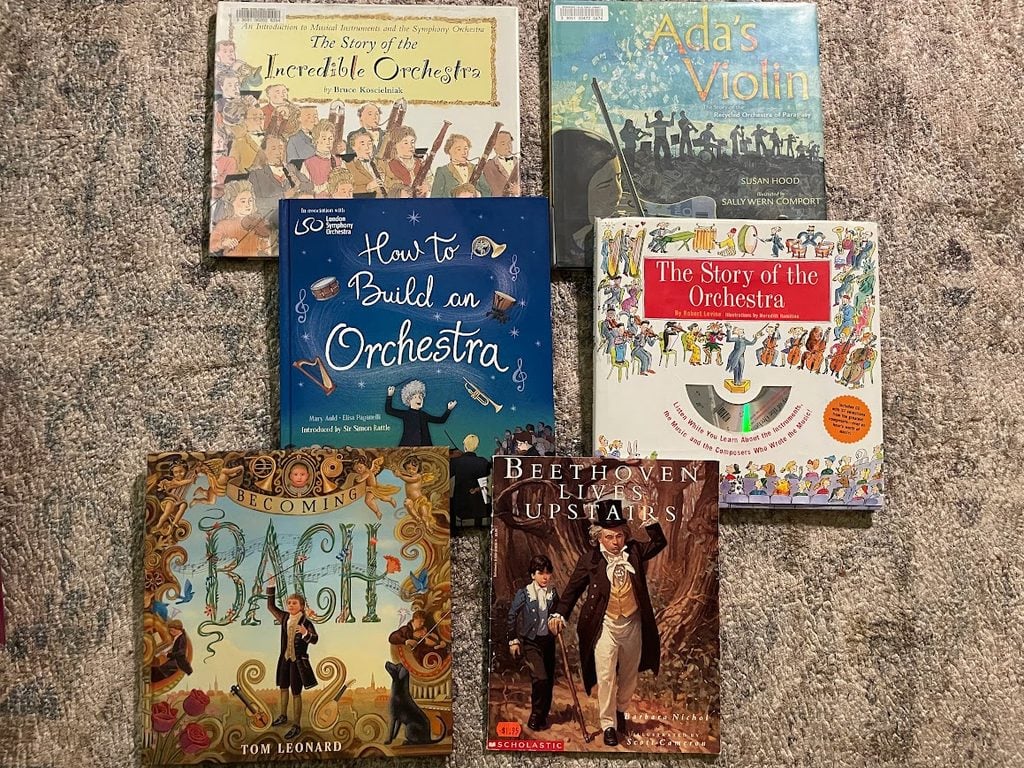
- The Story of the Orchestra by Robert Levine (comes with a CD so you can hear each instrument described!)
- How to Build an Orchestra by Mary Auld (comes with access to online tracks to listen to each instrument!)
- The Story of the Incredible Orchestra by Bruce Koscielniak (focuses on the history of the orchestra and how it has grown & changed throughout time)
- Welcome to the Symphony by Carolyn Sloan (with buttons to press, perfect for younger kids!)
- Ada’s Violin by Susan Hood (a true story!)
Picture Books About Composers/Performers
- Beethoven Lives Upstairs by Barbara Nichol
- I, Vivaldi by Janice Shefelman
- Becoming Bach by Tom Leonard
- Dancing Hands by Margarita Engle
- Duke Ellington by Andrea Davis Pinkney
- Ella Fitzgerald by Andrea Davis Pinkney
- Trombone Shorty by Troy Andrews
- The Man With the Violin by Kathy Stinson
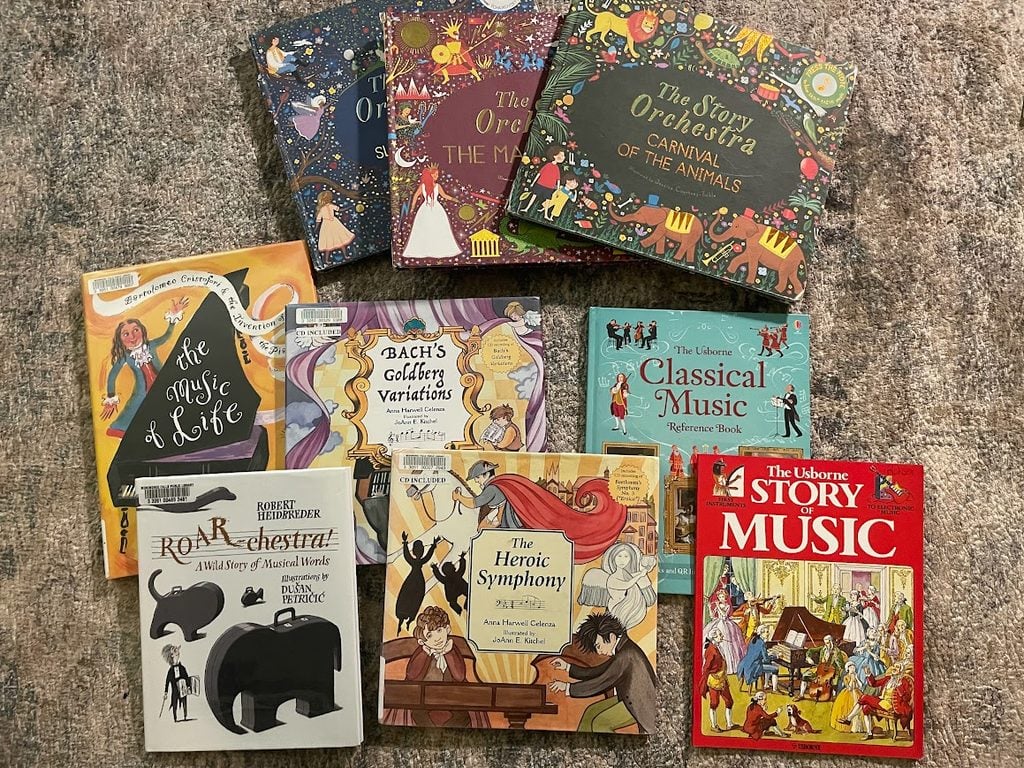
- Bach’s Goldberg Variations by Anna Harwell Celenza
- The Heroic Symphony by Anna Harwell Celenza
- The First Notes: The Story of Do, Re, Mi by Julie Andrews
Picture Books About Music in General
- all Story Orchestra Books by Katy Flint (the following are our favorites)
- The Usborne Story of Music by Simon Mundy
- The Usborne Classical Music Reference Book by Anthony Marks
- The Music of Life: Bartolomeo Cristofori & the Invention of the Piano by Elizabeth Rusch
- Roar-chestra by Robert Heidbreder
Conclusion
Entirely apart from the CONTENT of these fabulous picture books, there are so many fantastic reasons to read aloud to your children! Grab a few from your local library, snuggle up on the couch with your children, and learn a little bit more about the classical music that has shaped our history.
Sometimes the best thing we can do for our homeschool is to simply put wonderful books in front of our children, enjoy them together, and trust that learning is happening.
What’s your favorite way to use picture books in your homeschool? Let me know in the comments!
Read more on this topic: